

A Field Study on Agricultural Fintech & Payments
A Redbud VC × Gotham Chi Field Study
Contents
Executive Summary
Market Overview & History
Current Landscape Analysis
Market Map
Key Findings & Insights
Business Model Analysis
Investment Thesis & Areas of Opportunity
Market Risks & Headwinds
Appendix
Executive Summary
This field study evaluates early-stage venture opportunities in agricultural fintech and payments — the infrastructure that moves money between farmers, grain elevators, and lenders. It draws on primary interviews with farmers, bankers, and AgTech operators, including Bushel's CEO and Head of Payments, plus USDA, Federal Reserve, and Farm Credit System data.
Investment Recommendation: Invest in this market, but only via software platforms that integrate directly into grain elevators (like Bushel). Do not invest in generic payment apps or direct-to-farmer software. The most successful companies will own the software that handles the paperwork where physical grain is traded.
Thesis: Previous AgTech investing ($12–$15B from 2014–2024) failed because it focused on information (satellite imagery, field sensors) instead of cash flow. Agriculture is the largest paper-based sector in the U.S. economy: 80%+ of B2B transactions are settled via paper check. Major returns will go to software that digitizes the scale ticket at the grain elevator. Controlling that data lets a platform add services on top: faster loan tools, fraud detection, and specialized bank accounts.
Why Now? Even though FedNow has been up for 2.5 years, a dominant winner hasn't emerged because federal rails need modern APIs. The bottleneck is that elevators still run on fragmented, outdated ERP systems, and the software has to be built into them. Furthermore, elevators previously resisted digitization to keep the 14-day check "float" for free capital. Now, with input costs up 47% and interest rates at 7–8%, farmers cannot afford the delay, forcing elevators to finally upgrade or lose their growers.
Handling Big Tech and Bank Competition:
If Stripe buys a company like Bushel: It proves our thesis right. A generic payment giant cannot build a farming network from scratch because they lack ag-specific software — they cannot handle the unique rules of a grain sale, like automatically splitting a single payment between the farmer and the bank that holds a lien on the crop.
If CoBank builds in-house: Ag banks are built to manage loan portfolios, not to act as fast-moving software startups. These traditional institutions view fintech startups as necessary software partners to help them organize and track farm data, not as threats.
Market Overview & History
Agriculture is one of the last major sectors of the American economy still operating mostly by paper. While real-time payments settled over $500 billion in transactions across retail and commercial banking in 2025, an Iowa farmer who delivered 50,000 bushels of corn to a grain elevator on a Thursday afternoon could expect to wait a week or more for his settlement check, and often closer to two. This is not a technology problem: it is a structural one that has been built over a century by institutions, incentives, and relationships that made paper work well enough for long enough that nobody had reason to change.
That is, until now. The following pages trace the arc of that structure: from its origins in the New Deal to its near-collapse under input cost inflation and rising interest rates, through the billion-dollar satellite data bubble that tried and failed to solve the wrong problem, and finally to the 2026 inflection point where the right tools (real-time payment rails, embedded software, and digital scale ticket infrastructure) are converging with the right demand.
The Old Guard Era: A Century of Handshake Lending (1916–2020)
To understand why digital ag-finance is so hard to build, it's important to figure out why the paper-based system lasted as long as it did. For most of the twentieth century, the institutions and practices of agricultural lending were well-suited for the industry they served.
The Farm Credit System was created by Congress in 1916 under President Woodrow Wilson, creating the first permanent source of long-term agricultural credit in the United States. Before the FCS, farmers relied on commercial banks that charged very high short-term rates, or on local merchant credit. The FCS introduced farmer-owned cooperative lending: farmers borrowed from institutions in which they also held equity, creating accountability that made credit cheaper and more stable.
The most important practice was the grain elevator and cooperative system. Local elevators did not just buy and store grain, they were essentially the financial backbone of rural America. An elevator manager who knew a farmer's acreage and history could provide credit lines through arrangements that gave farmers access to capital months before harvest. The check used to facilitate this grain delivery was a relationship and trust-based financial arrangement that no third-party fintech platform could replicate without the same decades of trust.
This system kept working through the farm crisis of the 1980s, the commodity boom of 2007–2012, and the low-rate environment of the 2010s. Through all of these events, the paper check remained.
However, problems with this began appearing in 2021 and became worse by 2023–2024. Input cost inflation raised the average cost of a corn input package (the combined cost of all resources to produce an acre of corn) from approximately $380 per acre in 2020 to over $560 per acre in 2023, a 47% increase in three years. Combined with this, the Federal Reserve's rate cycle pushed farm operating line rates from near-zero to 7–8%. A farmer who once paid negligible additional costs on the settlement gap was paying roughly $2,700 in interest on a $1 million operating line over a two-week wait in 2024. The handshake and "trust" system was now expensive and unsustainable on top of being inconvenient.
The Data Bubble: Billions Spent Looking at Farms (2014–2024)
Between 2014 and 2024, venture capital and big agriculture funds put $12–$15 billion into 'AgTech.' The thesis was that if you could see a farm from space, you could optimize it. Satellite imagery companies, IoT sensor platforms, soil health analytics firms, and drone-based crop monitoring startups all raised large rounds on the premise that data-driven farming was the future of agriculture.
Some built very impressive technology: Planet Labs achieved near-daily satellite coverage of every agricultural acre in the U.S. The Climate Corporation, acquired by Monsanto for $930 million in 2013, built yield prediction models. Farmers Business Network raised over $500 million to build a data-sharing cooperative. Even though these advanced technologies worked, their business models unfortunately did not.
The reason is that AgTech investors were solving information problems where the real problem was a financial one. A farmer who is cash-constrained in March because she's waiting for a grain check from January and needs to buy seed now does not need better satellite imagery of her field; she needs money fast. Clearly, there was a mismatch between the thesis and the actual pain point of the agricultural industry.
The companies that succeeded in this data bubble did so by pivoting from selling data to building infrastructure. Bushel's trajectory is a great example: what began as a grain monitoring app became the dominant commercial portal software for grain elevators. And once it was embedded in elevators, it was positioned to become a financial infrastructure company. The takeaway from this is that in agriculture, the distribution channel is the product. The main goal shouldn't be to sell to farmers, but rather to sell to the institutions farmers already trust.
What the Data Bubble Got Wrong
The 2014–2024 AgTech era conflated farm productivity optimization (a real but slowly-burning problem) with farm financial operations (an acute and daily pain point). Satellite maps help farmers grow more. Digital payments help farmers survive the gap between growing and getting paid. The second problem is more urgent, more universal, and far more responsive to a fintech solution. The next decade of agricultural investment will be denominated not in sensors and imagery, but in wallets and settlement rails.
The 2026 Inflection Point
In the past year, four structural shifts have created an opportunity that did not exist even just a couple of years ago.
Payment rails have been established. FedNow (launched July 2023) and RTP (Real-Time Payments Network) together cover over 65% of U.S. bank accounts with 24/7 instant settlement capabilities. This federal investment in infrastructure has removed the technical barrier to instant settlements in agriculture.
An advanced enough software layer has been put in place. For example, Bushel processes scale ticket/transaction data for 3,500+ grain and ag retail locations, enabling the fintech layer to be built on top without requiring farmers to adopt anything new.
A fraud crisis has emerged. B2B check fraud reached an all-time high in 2025, with agricultural transactions being disproportionately targeted. This can be attributed to reliance on paper checks and poor regulation/oversight.
$1.5 trillion in farmland will change hands to a new generation over the next 15 years. These incoming younger farm operators, who are more digitally aware, will inevitably see the inefficiency of paper checks and necessity of digitization.
Current Landscape Analysis
The economic system of American grain agriculture is more complex than it appears from the outside. A bushel of corn doesn't go from field to fork, it passes through a network of financial arrangements: input financing, operating lines, forward contracts, and settlement checks. These together determine the cash flow of a farming operation in a given year. Finding where the fintech opportunity lies for agriculture means understanding this network and the complex landscape of the industry.
Macro Drivers: PESTLE Analysis
Six macro forces are reshaping the agricultural fintech landscape simultaneously:
Factor | Theme | Analysis & Supporting Data |
|---|---|---|
Political | Farm & Federal Policy | The USDA guarantees or directly holds roughly $30 billion of the approximately $500 billion U.S. farm debt market, making agriculture one of the most politically protected sectors in the U.S. economy. |
Economic | Input Cost Inflation & Rate Pressure | From 2020 to 2023, the average cost of a corn input package (seed, fertilizer, fuel) rose 47%, squeezing margins for mid-size operators. The Federal Reserve's rate cycle raised the cost of short-term operating lines from near-zero to 7–8%, making cash-flow timing a metric for survival and not just efficiency. |
Social | Generational Transfer & Digital Natives | The USDA projects that 40% of U.S. farmland will change hands in the next 15 years, valued at over $1.5 trillion. The incoming generation of operators are digital natives who already use Venmo and Zelle. This generational shift is the fuel that makes agricultural digitization inevitable across the next decade. |
Technological | FedNow, RTP & Real-Time Rails | The Federal Reserve's FedNow Service (launched July 2023) enables instant, 24/7 bank-to-bank transfers. Combined with The Clearing House's RTP network, real-time payment infrastructure now reaches over 65% of U.S. demand deposit accounts. The technical barrier to instant agricultural settlement — the actual movement of money — has been removed by federal infrastructure investment. The only remaining barrier is the software layer connecting grain elevator workflows to these rails. |
Legal | BSA/AML Compliance & Scale Ticket Legality | The Bank Secrecy Act and AML regulations require institutions handling large agricultural payments to maintain detailed transaction records. Digitizing the scale ticket (legal proof of grain delivery) will strengthen compliance. A digital audit trail is harder to falsify than a paper check. |
Environmental | Climate Volatility & Parametric Insurance | The American Farm Bureau Federation reported that climate-related crop losses averaged $21 billion annually from 2018–2023. This volatility is driving adoption of parametric insurance products that pay out automatically based on weather data, creating a new category of financial settlement that didn't exist five years ago. Environmental pressure is also increasing the demand for alternative credit scoring and accelerating the replacement of slow, paper-based claims processes with instant digital settlements. |
To understand the current market landscape, it helps to trace the "lifespan" of a single dollar through the agricultural network, from origin to destination. Currently, a farmer's revenue starts not when grain is delivered, but rather when their check clears (days to weeks later). In between, this money goes through a chain of financial processes: the grain elevator buys the crop, the elevator's bank holds the funds, the postal system carries the check, and finally the farmer's bank accepts the deposit and has its own hold period. Each one of these handoffs in the chain brings compounding delays, therefore bringing costs.
What's uniquely complex about agricultural payments is that the financial transactions and physical transactions are already separated by weeks or potentially months. It could be the case that a farmer who sold their grain in October by means of a forward contract (a binding agreement to sell at a set price on a future date) signed in June waits for settlement longer than most people wait for paychecks. When you consider the addition of a two-week mail delay on top of that, this system is clearly flawed. It's flawed not just because the delays are a nuisance, but because they harm the farmer's liquidity and ability to purchase resources for the next season. Farmers are on tight seasonal schedules with Spring planting and Fall harvest, so if their capital arrives late it is often useless.
Grain elevators are the operational and financial gatekeepers at the center of this network. They work as the primary buyer, a credit provider, and a point of contact for any technology adoption. This is why fintech companies that have tried to subvert the elevator and sell directly to farmers have failed. The elevator is the trust infrastructure that every financial relationship in the network is built upon. Bushel recognized this and built software for elevators instead of farmers, building credibility, which allowed them to create even more products built on that relationship.
Community banks are also critical and even more threatened. At this level, lending is very relationship-based. Loan officers have a personal relationship with borrowers, and credit decisions are heavily based on character. That system worked well for decades, but it is now quickly starting to crumble due to competition from other credit sources and fintech lending systems that allow for faster approval with digital underwriting. Community banks will need to incorporate real-time data into their lending processes, or they will lose their best borrowers to lenders who have.
Market Map
Agri-Fintech and Payments Market Map
The market map organizes the agricultural fintech and payments landscape into four functional layers — Capital Stack, Digital Infrastructure, Risk & Security, and Payments & Settlement — each representing a distinct step in the journey from capital formation to final transaction.
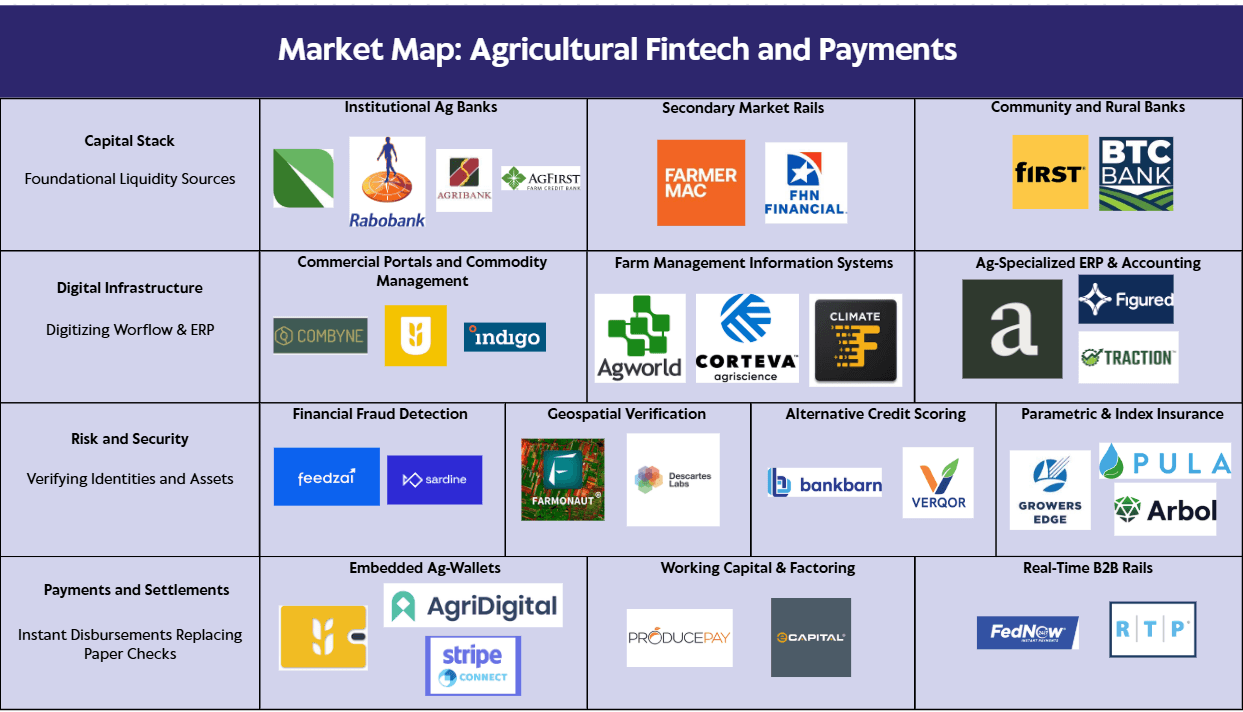
Layer 1 — Capital Stack (Foundational Liquidity Sources): Institutional Ag Banks (Rabobank, AgriBank, AgFirst), Secondary Market Rails (Farmer Mac, FHN Financial), Community and Rural Banks (First Financial, BTC Bank)
Layer 2 — Digital Infrastructure (Digitizing Workflow & ERP): Commercial Portals and Commodity Management (Combyne, Bushel, Indigo), Farm Management Information Systems (Agworld, Corteva Agriscience, Climate FieldView), Ag-Specialized ERP & Accounting (Ambrook, Figured, Traction)
Layer 3 — Risk and Security (Verifying Identities and Assets): Financial Fraud Detection (Feedzai, Sardine), Geospatial Verification (Farmonaut, Descartes Labs), Alternative Credit Scoring (BankBarn, Verqor), Parametric & Index Insurance (Growers Edge, Pula, Arbol)
Layer 4 — Payments and Settlements (Instant Disbursements Replacing Paper Checks): Embedded Ag-Wallets (Bushel Wallet, AgriDigital, Stripe Connect), Working Capital & Factoring (ProducePay, Capital), Real-Time B2B Rails (FedNow, RTP)
Layer 1: The Capital Stack (Foundational Funding)
This layer represents the primary liquidity sources. While institutional giants like CoBank and Rabobank hold the largest debt portfolios, the 2026 trend is toward Secondary Market Liquidity. Farmer Mac is the critical player here, buying loans to provide local banks with the capital needed to maintain rural lending. Traditional banks are increasingly seeking fintech partners to automate their legacy underwriting processes.
Layer 2: Digital Infrastructure & ERP (The Data Source)
This is where Physical Ag meets Digital Finance. Commodity Management & Commercial platforms (e.g., Bushel) act as the primary interface between the elevator and the farmer. In 2026, these are no longer just portals; they are Data Aggregators. Ambrook and Figured have emerged as the "Financial OS" for the farm, moving to real-time, audit-ready cloud systems. By tracking contracts, scale tickets, and financial data, companies in this layer are able to provide information to Layer 3.
Layer 3: Risk, Fraud & Security
This is the most critical bottleneck for 2026. As transactions move to instant rails, Financial Fraud Detection (e.g., Feedzai, Sardine) is mandatory to stop high-value wire fraud and "check-kiting." Simultaneously, Geospatial Verification (e.g., Farmonaut) provides "Proof of Crop," ensuring the underlying asset actually exists. Alternative Credit Scoring (e.g., BankBarn) uses this real-time data to score the "credit-invisible" farmer, creating a new bridge for Layer 1 capital to reach underserved producers.
Layer 4: Payment Rails & Settlement
The 2026 market is defined by Embedded Ag-Wallets (e.g., Bushel Wallet) that keep capital within the ecosystem. By offering instant disbursements via FedNow and RTP, these wallets eliminate the 14-day paper check cycle. ProducePay represents the "Liquidity-as-a-Service" model, providing immediate post-harvest cash, which is vital in a high-interest-rate environment where cash-flow timing is a survival metric.
Bushel's Vertical Integration
Bushel's strategic position is unique and represents the gold-standard business model for agricultural fintech. Starting in Layer II as an elevator portal, they have expanded into Layer IV (Bushel Wallet). By controlling both the data source (scale ticket) and the payment (wallet), they have created a closed-loop financial system within the grain elevator ecosystem that is resistant to horizontal fintech entrants (who lack ag-specific data) and incumbent banks (who lack elevator relationships). The vertically integrated data + payments model is the blueprint for the next generation of ag-fintech winners.
Takeaways
Value is shifting to companies that can move data seamlessly from an ERP (Ambrook) to a Bank (CoBank) while being verified by a Security layer (Sardine).
Risk & Fraud (Layer 3) is the most underserved segment. VCs should look for founders building tools that understand complex farm structures.
Success in 2026 requires being part of an integrated technology package. If a fintech tool doesn't talk to the farm's management software, it will be discarded in favor of embedded solutions.
Key Findings & Insights
The Paper Stalemate
Despite the digitization of other sectors, approximately 80% or more of B2B agricultural payments remain paper-based. This paper habit is sustained by three primary factors:
The Float Incentive: Grain elevators benefit from the 14-day delay that occurs while they wait for a paper check to clear their accounts. This provides them with "free money" that can be used as short-term liquidity. Moving to instant digital payments removes this financial cushion, creating a disincentive for elevators to modernize.
Outdated Infrastructure: Most elevators operate on old software and approval chains designed solely for paper. A digital transformation requires more than an update, but a complete and complex replacement of decades-old tracking systems.
Demographic and Connectivity Hurdles: The industry is known for an aging constituency (many farmers and cooperative leaders are 80+ years old) that prefers traditional, relationship-based physical transactions. The connectivity deserts typical of rural farmland make it so digital tools often fall short of paper, unless they offer specific offline functionality.
Trust Gap and Data Sovereignty
A significant barrier to entry/adoption is the distrust among farmers regarding how financial and crop data will be utilized by larger farming corporations and tech companies:
Transparency Fears: Farmers fear that digital "transparency" will be used against them, specifically that companies might use their yield and financial data to hike interest rates or lower the price offered for their grain.
Security as a Non-Negotiable: As the industry moves from slow paper checks to instant digital transfers, it becomes a high-value target for cyber-criminals. A single redirected six-figure payment could permanently destroy a farmer's trust in digital platforms, making specialized fraud detection and multi-factor authentication essential requirements.
The Scale Ticket
The most critical pivot point for digital transformation is the Scale Ticket: the receipt a farmer receives at a grain elevator proving crop delivery.
Embedded Finance Strategy: Currently, successful companies are embedding financial tools directly into the workflow software that grain elevators already use to create these scale tickets, eliminating the need for farmers to adopt new apps.
Vertical Integration: Companies like Bushel are leading by owning both the data (contracts and tickets) and the money (the "Bushel Wallet"). This "closed loop" system allows for instant disbursements via FedNow and RTP, eliminating the 14-day check cycle while creating a defensible moat against horizontal competitors like Stripe.
Specialized Accounts: There is a massive untapped opportunity for a "Bank account for the American farmer" that offers high interest (e.g., 2.75%, against the sub-1% typical of rural business checking) and expanded FDIC insurance (up to $5M) to protect the large, seasonal lump-sum payments farmers receive.
The Role of AI and Risk Mitigation
Artificial Intelligence is moving from a "future tech" to a core operational necessity in 2026:
Software Productivity: AI is being used to build software 20x faster, with some companies reporting that 25% of their code is now AI-generated.
"Proof of Crop" and Underwriting: Traditional underwriting is arduous and antiquated. New AI-driven "Alternative Credit Scoring" (e.g., BankBarn or Farmonaut) uses satellite data to provide "Proof of Crop," allowing lenders to verify assets in real-time without physical inspections.
Niche Fraud Detection: General fraud tools are insufficient for agriculture. The industry needs specialized AI (like Feedzai) to flag irregular behaviors specific to agriculture, such as double-pledged crop collateral or warehouse receipt fraud.
Strategic Takeaways: Partnership Over Disruption
Local Loyalty: Farmers hold deep loyalty to their local community banks and elevators. Successful fintech strategies must focus on partnership rather than disruption, providing digital tools to local institutions to help them stay competitive rather than trying to put them out of business.
Seamless Integration: If a fintech tool does not integrate directly with existing farm management or ERP software (like Ambrook or Figured), it will likely be discarded. Success in 2026 requires being part of a fully integrated technology package.
Business Model Analysis
The agricultural fintech (Ag-Fintech) sector is undergoing a structural shift from traditional, relationship-based lending to data-driven digital systems. The following analysis outlines the core components of the emerging business models within this space.
Value Propositions
Ag-fintech companies deliver distinct value across the agricultural supply chain:
For Farmers: The primary value lies in speed and security. Digital systems replace the 14-day mail-and-check cycle with instant disbursements via rails like FedNow and RTP. Specialized accounts offer high interest (e.g., 2.75%) and expanded FDIC insurance (up to $5M) to protect large seasonal lump sums.
For Grain Elevators & Retailers: These platforms provide workflow automation by digitizing the "Scale Ticket" — the most critical document in a farmer's life. This reduces manual back-office labor and friction in B2B transactions.
For Lenders: Fintechs provide "Proof of Crop" via geospatial verification and alternative credit scoring. This real-time data allows banks to automate legacy underwriting processes and safely lend to "credit-invisible" or mid-sized farmers.
Customer Segments
The market is segmented by the role each player serves in the crop-to-cash cycle:
The "Gatekeepers" (Elevators & Co-ops): The primary entry points for fintech. They own the relationships and the data (contracts and tickets).
The "Primary Users" (Farmers): While older generations (80+) remain a hurdle, more tech-savvy Gen X farmers are driving adoption of mobile-first financial tools.
The "Capital Providers" (Banks & Secondary Markets): Institutional banks (e.g., CoBank, Rabobank) and secondary market players like Farmer Mac seek fintech partners to maintain rural lending liquidity.
Revenue Streams
Modern Ag-fintechs utilize a multi-layered revenue model:
Transaction Fees: Collecting small percentages or flat fees on the billions of dollars in grain sales processed through digital rails.
SaaS & Workflow Fees: Subscription-based revenue from providing essential ERP and commodity management software to elevators (e.g., Bushel, Ambrook).
Financial Spreads: Interest income generated from deposits in specialized farm business accounts or spreads on tech-enabled lending products.
Data Monetization: Processing and selling anonymized data to help institutions better understand market trends or underwrite loans.
Key Activities & Infrastructure
Vertical Integration: Successful models, like Bushel's, involve owning both the data source (Layer 2 workflow software) and the financial tool (Layer 4 embedded wallet).
Lien & Fraud Management: Developing "smart contracts" to handle complex distributions where both a farmer and a lien-holder must be paid simultaneously from a single grain sale.
AI-Enhanced Productivity: Utilizing AI to build software up to 20x faster, with some leaders reporting that 25% of their code is now AI-generated.
Competitive Moats & Defensibility
The Ag-Fintech moat is built on specialization and integration:
Resistance to Horizontal Giants: It is nearly impossible for horizontal payment providers (like Stripe or Square) to disrupt this space because they lack ag-specific integrations like scale ticket workflows and lien resolution.
Embedded Moat: Once a fintech tool is embedded into an elevator's ERP or a farm's management software, it becomes part of the "Financial OS" of the farm, making it highly "sticky."
The Trust Layer: Success relies on partnership rather than disruption — empowering local community banks and elevators with digital tools rather than attempting to replace them.
Investment Thesis & Areas of Opportunity
The Core Thesis: From AgTech to Ag-Finance
For the last decade, the dominant narrative in agricultural technology centered on sensors, satellite imagery, and precision farming tools. The underlying assumption was that better data about crops would translate into investment returns. That bet largely failed. Farmers proved unwilling to pay subscription fees for data platforms that did not directly improve their cash flow.
The 2026 opportunity is structurally different. Agriculture is the largest remaining sector of the U.S. economy still running on paper-based financial infrastructure. Over 80% of B2B agricultural payments are still processed by check — a system that introduces 14-plus-day settlement delays, counterparty risk, and significant fraud exposure. The companies positioned to capture value in this cycle are not those looking at the farm, but those handling the farm's money.
This thesis is supported by a convergence of three factors: farmers who are increasingly ready for digital tools but are being underserved by incumbent institutions, a new generation of infrastructure companies that have embedded themselves in existing agricultural workflows, and rising macro pressure from high interest rates that make cash-flow timing a survival issue — not merely a convenience.
Three Thesis Pillars
Pillar I: Digital Settlement Rails | Pillar II: Alternative Credit Infrastructure | Pillar III: Vertical Integration & Data Moats |
|---|---|---|
Replace 80%+ paper check volume with instant B2B payment infrastructure embedded at the grain elevator. | Satellite and transaction data replace subjective underwriting, unlocking credit access for thousands of underserved farm operations. | Platforms that own both workflow software and payment rails create defensible closed-loop systems with compounding network effects. |
Pillar I: Digital Settlement Rails
The most immediate and scalable opportunity in ag-fintech is the digitization of grain payment settlement. Today, a farmer delivers corn to a grain elevator, receives a paper scale ticket, and waits up to two weeks for a check to arrive by mail. This is not a farmer behavior problem — it is an infrastructure problem.
"Farmers are ready. It's the tech that lags behind. Clunky chain of operations — if you visit an ag retailer it's like going back 30 years of technology." — Jake Joraanstad, CEO of Bushel
Bushel represents the clearest current expression of this thesis. By embedding workflow software at grain elevators — capturing contracts, scale tickets, and delivery data — Bushel has positioned itself as the digital layer between farmer and buyer. The Bushel Wallet and Bushel Pay extend that position into financial services, enabling instant settlement, direct deposit, and integrated lien management. This is the trucking industry's FleetCor model applied to agriculture: a purpose-built financial product for a constituency with unique, high-value transaction needs.
The financial product design matters. Bushel's Business Account offers 2.75% interest and $5 million in FDIC pass-through insurance — directly addressing the legitimate concern that farmers receiving six-figure grain checks face real FDIC exposure at standard $250,000 limits. This is not incidental; it is a product feature that incumbent consumer banks structurally cannot match without ag-specific design.
The medium-term opportunity is even larger. FedNow and RTP rails are live and capable of settling high-value B2B transactions instantly — including on weekends. The gap is not in federal infrastructure but in the last-mile integration between those rails and the ag-specific workflow software where the transaction originates. Companies that own that integration own the payment.
Looking further out, smart contract infrastructure — pioneered in agriculture by AgriDigital in Australia — offers the ability to automate complex multi-party payment distributions. In a typical grain sale, a farmer may owe a portion of the proceeds to an input lender who holds a lien on the crop. Today, that reconciliation is manual, slow, and error-prone. A smart contract settles all parties simultaneously at the moment of delivery. Tony Morisini (Bushel Head of Payments) and Joraanstad both identified this as the five-year direction for the industry. Early-stage companies building toward this infrastructure represent compelling pre-seed and seed-stage opportunities.
Pillar II: Alternative Credit Infrastructure
Agricultural lending in the United States is dominated by a small number of Farm Credit System institutions and large regional banks. These institutions rely on a standardized underwriting process — one that applies equally to a $50,000 operating line and a $2 million expansion loan, regardless of the borrower's actual crop health, payment history, or demonstrated performance. The process is slow, relationship-dependent, and increasingly ill-equipped to serve the long tail of mid-sized independent farm operators.
"Everyone goes to the same traditional underwriting process. It's arduous and antiquated — it doesn't take into account specific situations and isn't using AI or any differentiation for different consumer needs." — Jacquelin Mosier, Ag Fintech Operator
The alternative credit opportunity is to build a verification layer that replaces branch visits and manual document review with real-time data. Satellite-based crop verification (Farmonaut) can confirm that a farmer's collateral — the growing crop — physically exists and is healthy. Transaction-based scoring (BankBarn) can use a farmer's grain delivery history, payment patterns, and commodity contract data to generate a credit profile that traditional FICO scores entirely miss. Together, these tools enable lenders to say yes faster, with more confidence, to borrowers they would otherwise decline.
This is not a displacement play against the Farm Credit System. It is a partnership play. Community banks and rural lenders already want to serve these farmers but lack the tools to do so efficiently. The winning model is to give those institutions an AI-assisted underwriting layer that makes them competitive with larger banks — not to build a competing lender from scratch. CoBank's interest in monetizing its co-op farm data as an alternative revenue stream is a direct expression of this dynamic: the incumbent has the relationship and the data; the fintech company provides the infrastructure to make both productive.
Pillar III: Vertical Integration and Data Moats
The most durable businesses in ag-fintech will not be point solutions. They will be platforms that own multiple layers of the agricultural financial stack simultaneously, creating switching costs that neither incumbent banks nor horizontal fintech companies can overcome.
The Bushel architecture illustrates this logic clearly. The company began in Layer 2 (digital infrastructure) by providing workflow software to grain elevators. That position gave it access to transaction data — contracts, scale tickets, delivery records — that no other financial institution possesses at scale. It is now using that data to move into Layer 4 (payment rails), offering the Bushel Wallet and Bushel Pay as embedded financial products. The result is a closed-loop system: Bushel owns the data that proves a farmer's crop exists, and it owns the payment infrastructure that settles the transaction. Horizontal competitors like Stripe cannot replicate this without deep ag-specific integrations that would take years to build.
"No direct competitors on the payment side. No Stripe or Square for agriculture — Bushel is trying to be that." — Tony Morisini, Head of Payments, Bushel
For investors, this suggests a diligence framework that prioritizes platform companies with existing workflow penetration over pure payment or pure data plays. A company that already touches the daily operational workflow of a farmer or elevator operator has a distribution advantage that is nearly impossible to acquire through sales alone. The question is whether that company has the product vision and capital to extend into adjacent financial services before a well-funded horizontal player attempts to enter.
Areas of Opportunity: Investment Framework
The following matrix maps five key investment areas identified through primary research, assessed across stage, market size, urgency, and representative companies. Market sizes are sized conservatively against the segments most likely to buy at each price point, not full addressable universes:
Opportunity Area | Stage Focus | Market Size | Urgency | Key Company |
|---|---|---|---|---|
Digital Payment Rails | Seed–B | $600M ($400B paper volume × 0.15% fee) | High | Bushel |
Alternative Credit Scoring | Seed–B | $300M ($60B stalled loan volume × 0.50% fee) | High | BankBarn, Farmonaut |
Ag-Specific Fraud Detection | Seed–C | $75M (1k larger commercial elevators × $75k annual SaaS) | High | Feedzai, Sardine |
Embedded Financial OS (ERP) | A–C | $240M (200k commercial farms × $1,200/yr) | Medium | Ambrook, Figured |
Stablecoin / Smart Contracts | Pre-Seed–A | $400M ($400B complex grain volume × 0.10% fee) | Emerging | AgriDigital |
Stage Considerations
Given the dual-stage mandate, the following framework applies:
Seed / Series A: Ag-specific fraud detection, smart contract payment infrastructure, satellite-based alternative credit tools. These are early markets with clear pain points and limited capitalization to date. Founder-market fit and technical differentiation are the primary diligence criteria.
Series B / Growth: Digital payment rails with existing elevator penetration (Bushel model), embedded ERP/accounting platforms with demonstrated farmer retention. Diligence focus shifts to unit economics, net revenue retention, and the defensibility of the data moat.
Across all stages, the highest-conviction investments will be those that partner with — rather than compete against — incumbent institutions. Farmers maintain deep loyalty to their local banks and elevator operators. Platforms that give those incumbents better tools will outperform platforms that attempt to disintermediate them.
Market Risks & Headwinds
The ag-fintech opportunity is compelling — but it operates in a context that introduces risks that are structurally different from those facing consumer or enterprise fintech. These are not reasons to avoid the space; they are factors that should sharpen diligence criteria and inform portfolio construction. The following six risk categories were identified through primary research with operators, lenders, and farmers across the ecosystem.
Risk Summary Matrix
Risk Factor | Likelihood | Impact | Mitigation |
|---|---|---|---|
Adoption Resistance / Digital Divide | Medium | High | Back incumbent banks and elevators; don't bypass them |
Cybersecurity & Payment Fraud | High | High | Require ag-specific fraud stack (Feedzai, Sardine) in portfolio companies |
Rural Connectivity Gaps | High | Medium | Offline-first architecture as diligence requirement |
Regulatory / Stablecoin Uncertainty | Medium | High | Stage exposure; invest in compliant rails-first companies |
FDIC / Wallet Coverage Limits | Medium | Medium | Back platforms with $5M+ FDIC pass-through (Bushel model) |
Market Concentration Risk | Low | High | Avoid single-elevator dependencies; prioritize network effects |
Risk 1: Adoption Resistance and the Digital Divide
Likelihood: Medium | Impact: High
The most consistently cited barrier across every interview in this study was not technology — it was the aging demographic of the American farming population. Farm operators skew significantly older, with many elevators and co-ops still managed by individuals who have run their businesses on paper checks and personal relationships for decades.
"People are very old in the industry — they don't retire. 80-year-olds like the lifestyle, visiting the elevator and fertilizer supplier. It's just an older constituency." — Tony Morisini, Head of Payments, Bushel
This is a real headwind, but it is a time-bounded one. The succession dynamic is already underway — farms are passing to Gen X and millennial operators who are meaningfully more technology-comfortable. Jake Joraanstad noted that farmers are already running grain dryers and combines via smartphone apps; the mental model for mobile management of physical assets already exists. The gap is in financial tools that meet them in workflows they already use, not standalone apps that require behavioral change.
The mitigation framework is clear: invest in companies that embed in existing workflows (grain elevator software, co-op portals) rather than those requiring farmers to download and learn a new application. The distribution channel matters as much as the product.
Risk 2: Cybersecurity and High-Value Payment Fraud
Likelihood: High | Impact: High
The move from paper checks to instant digital payment rails is not a neutral transition from a security standpoint. Paper checks are slow and cumbersome, but they are also reversible — a fraudulent check can often be stopped before it clears. Instant payments settled over FedNow or RTP are irrevocable. Once sent, the money is gone.
This creates acute risk in an industry characterized by very high transaction values. A single grain sale can represent $100,000 to $500,000 or more. A single wire fraud incident — a spoofed invoice, a compromised account, a rerouted payment — could represent a farm's entire annual revenue. B2B check fraud hit record highs in 2025, and the migration to digital rails, while necessary, will initially increase vulnerability before improved tooling reduces it.
"A major goal is simplifying digital wallets tied directly into ERP systems. The most intriguing upcoming opportunity is instant, high-value payment systems that function like a business version of Venmo — but current solutions remain hindered by concerns over irrevocable scams." — Jessica Lehman, First Financial Bank
Agricultural transactions carry additional fraud vectors that generic fintech fraud detection tools are not calibrated for: double-pledged crop collateral, warehouse receipt fraud, commodity insurance abuse, and crop verification manipulation. Feedzai and Sardine provide AI-driven behavioral anomaly detection that outperforms traditional dollar-threshold flagging, but neither is specifically optimized for agricultural transaction patterns. This gap represents both a risk for the ecosystem and an investment opportunity for a company that builds ag-native fraud intelligence.
Risk 3: Rural Connectivity Infrastructure
Likelihood: High | Impact: Medium
Digital payment infrastructure assumes connectivity. Much of agricultural America does not have reliable broadband or cellular coverage. A payment application that requires a constant internet signal to settle a grain transaction at a remote elevator is, in practical terms, less reliable than a paper check. This is not a hypothetical concern — it is a daily operational reality in the communities these platforms are trying to serve.
The implication for investors is to treat offline-first architecture as a non-negotiable diligence requirement, not a nice-to-have. Platforms that cache transaction data locally and sync when connectivity is restored can operate across the full geography of American agriculture. Those that do not will be limited to well-connected markets where the competitive pressure from incumbent banks is already highest.
The longer-term trajectory of rural broadband investment — through federal infrastructure programs and satellite internet expansion — will reduce this risk over time. But the five-year investment horizon requires platforms that can operate reliably today in environments where connectivity is intermittent.
Risk 4: Regulatory and Stablecoin Uncertainty
Likelihood: Medium | Impact: High
Several operators interviewed for this study identified stablecoins and smart contract infrastructure as the medium-term direction for ag payments — particularly for complex multi-party transactions involving farmers, grain elevators, and crop lenders. The technical case is compelling: programmable money that distributes payment to multiple counterparties simultaneously, with lien resolution automated at the moment of settlement, would eliminate one of the most friction-intensive processes in agricultural finance.
The regulatory environment, however, remains unsettled. Stablecoin legislation in the United States has been in progress without resolution, leaving the legal status of stablecoin-settled commercial transactions ambiguous. Companies building on this infrastructure face the risk that their core payment mechanism is reclassified or restricted before they reach scale.
"Stablecoins are too early — we're just getting off checks. But agriculture is the perfect use case. Smart contracts will handle the complexity of who gets paid what from a single grain transaction." — Tony Morisini, Head of Payments, Bushel
The investment implication is to stage exposure carefully. Early-stage bets on stablecoin-adjacent infrastructure should be sized accordingly — compelling optionality but with regulatory binary risk. Larger commitments should focus on companies building on proven rails (FedNow, RTP, ACH) with stablecoin capabilities as a future-state option rather than a current dependency.
Risk 5: FDIC Coverage Limits and Wallet Risk
Likelihood: Medium | Impact: Medium
Agricultural payment volumes frequently exceed the standard $250,000 FDIC insurance limit. A farmer receiving a large grain check deposited into a digital wallet with standard insurance coverage faces real principal risk if the holding institution encounters financial distress. This is not a theoretical concern — it is a structurally predictable consequence of applying consumer-designed financial products to commercial agricultural transaction scales.
Platforms that solve this problem — through pass-through FDIC insurance arrangements that aggregate coverage across multiple member banks — have a meaningful product advantage. Bushel's $5 million FDIC coverage structure is a direct response to this need. Investors should evaluate whether portfolio companies in the payment wallet space have structured their FDIC exposure appropriately, both as a diligence matter and as a signal of product sophistication.
Risk 6: Market Concentration and Incumbent Loyalty
Likelihood: Low | Impact: High
Agricultural financial relationships are deep and long-tenured. A farmer whose family has banked with the same community institution for three generations is not going to switch because a startup offers a marginally better interest rate. The social fabric of rural agricultural communities — where the banker, the elevator operator, and the farmer all know each other personally — is a genuine competitive moat for incumbents that no venture-backed platform can replicate through product alone.
This dynamic cuts both ways. It is a headwind for platforms attempting direct-to-farmer distribution. It is a tailwind for platforms that partner with those trusted incumbents and give them better tools. The former strategy will face customer acquisition costs that are very difficult to recoup. The latter strategy can leverage decades of relationship equity that incumbents have already built.
Additionally, platforms that become deeply integrated with a single large grain buyer or cooperative face concentration risk. If that relationship deteriorates — through a pricing dispute, a competing in-house build, or a strategic acquisition — the platform's revenue base may be structurally impaired. Diligence should evaluate customer concentration carefully and favor platforms with broad, diversified distribution across multiple elevator or co-op relationships.
Risk-Adjusted Thesis: Where Conviction Holds
None of the risks catalogued above invalidate the core investment thesis. They refine it. The companies most likely to generate returns in this cycle are those that:
Embed in existing workflows rather than requiring farmers or elevators to change behavior
Partner with incumbent banks and co-ops rather than displacing them
Build offline-first architecture that operates across the full rural geography
Invest in ag-native fraud detection as a first-class product requirement, not an afterthought
Structure payment products with appropriate FDIC coverage for commercial transaction scales
Treat stablecoin and smart contract infrastructure as a future option, not a current dependency
The structural shift from paper to digital in agricultural finance is not a question of whether — it is a question of when and which companies will own the infrastructure when it happens. Given that Bushel alone already touches 50%+ of U.S. grain origination, the digitization of the scale ticket is already underway. The next five years will determine which companies extend that position into the broader financial stack and which remain point solutions in an increasingly integrated ecosystem.
Appendix
Company Profiles
Traditional Lenders and Banks
CoBank What do they do? A member of the Farm Credit System, a government-sponsored program to lend money to farmers. They deal with co-ops, groups of farmers with more bargaining power than individuals — though companies like Farmers Business Network are increasingly bypassing co-ops to deal with farmers directly. As a result, co-ops need fintech to stay relevant and don't want to build tech in-house, so they need finance partners. VC Opportunity: CoBank has extensive data on its co-op farms and wants its co-ops to sell that data to fintech companies as a revenue stream when grain prices are low. This alternative revenue stream needs fintech to process and sell it — that's where the opportunity lies.
Digital Infrastructure Companies
Bushel What do they do? Digitizing the grain supply chain and automating B2B transactions between farmers and grain elevators. They embed themselves in this existing relationship and remove friction — the more farmers and elevators that join, the more effective it becomes. Also helps banks underwrite loans with accurate data on a large segment of the farming industry. VC Opportunity: As the system expands, it will be hard to be a farmer without using it. Everyone will need to get on this network, which is establishing itself as the go-to for transactions — good to get in early.
Digital Wallets and Disruptors
AgriDigital What do they do? A similar model — grain management for farmers with data insight and payments — but with a key difference: they've pioneered settling grain transactions through the blockchain. This eliminates the counterparty risk that comes with a check, where a buyer might not have the money after grain is delivered but before a check clears. This development allows transactions to occur instantly. VC Opportunity: Just finished a raise and isn't too large yet, so could be looking to raise more in the future. Based in Australia but looking to expand globally — significant growth potential given the uniqueness of their transaction system.
Risk and Fraud Mitigation Companies
Growers Edge What do they do? Helps mitigate risk for farmers and incentivizes them to try new crop plans. If a farmer fails to hit a yield with new products, Growers Edge pays out the difference between what they earned and what they projected — essentially crop insurance using fintech as a service. VC Opportunity: Just completed a Series C round last year, so more may be on the way.
Feedzai What do they do? Helps mitigate fraud risk across the growing digital payments landscape, using AI to flag transactions based on irregular behavior rather than the traditional dollar-threshold flagging system, reducing false positives. Especially useful for agriculture given elevated fraud risk from double-pledged crop collateral, warehouse receipt and commodity fraud, and crop insurance abuse. VC Opportunity: Potential for an agricultural niche filled by either a new company focused specifically on this, or further investment to tailor Feedzai to this vertical.
Data Sources & References
USDA Economic Research Service — Farm Income and Wealth Statistics (2024)
Federal Reserve — FedNow Service Launch Report & Adoption Data (2023–2025)
The Clearing House — RTP Network Statistics (2025)
Association for Financial Professionals — 2025 Payments Fraud & Control Survey
USDA National Agricultural Statistics Service — Grain Stocks & Crush Reports
Farm Credit Administration — Annual Report on the Farm Credit System (2024)
Farmer Mac — Annual Report & Secondary Market Statistics (2024)
USDA Risk Management Agency — Crop Insurance Summary of Business (2024)
Crunchbase / PitchBook — AgTech & Agricultural Fintech Funding Data (2014–2025)
Federal Deposit Insurance Corporation — Community Banking Study: Rural Agriculture (2024)
Bushel Inc. — Company materials and public statements
ProducePay — Company materials and press releases
Ambrook, Figured, BankBarn — Company materials and public statements
Primary interviews: conversations with farmers, bankers, AgTech founders, and agricultural lending officers (Jessica Lehman, Jacquelin Mosier, Tanner Ehmke, Jacqui Fatka, Tony Morisini, Jake Joraanstad)
