

An e commerce venture is a business that sells products or services to customers over the internet, ranging from small home-based operations to large international enterprises. These digital businesses can operate through their own websites, established marketplaces like Amazon, or social media platforms.
Key facts about e-commerce ventures:
Market size: Global e-commerce sales projected to reach $8.09 trillion by 2028
Business models: B2C (selling to consumers), B2B (selling to businesses), C2C (consumer-to-consumer marketplaces), and D2C (direct-to-consumer)
Revenue models: Dropshipping, subscription boxes, private labeling, wholesaling, and print-on-demand
Current growth: E-commerce accounted for 16.4% of total retail sales in Q4 2024
Startup potential: Independent sellers on Amazon averaged over $290,000 in annual sales in 2024
The digital retail landscape has transformed dramatically since the first online transaction in 1994. What started as a novelty has become ubiquitous—nearly 20% of all retail transactions now happen online, and that percentage continues to rise every year.
Starting an e-commerce venture today means entering a market with proven demand and accessible tools. Unlike traditional retail, you don't need expensive storefronts or massive upfront capital. Platforms like Shopify, WooCommerce, and marketplaces like Amazon have lowered the barriers to entry significantly. You can launch from anywhere with a laptop and internet connection, reach customers globally, and operate 24/7 without being tied to rigid schedules.
But the opportunity comes with real challenges. Competition is intense, supply chains can be fragile, and customer acquisition costs are 20-40% higher than traditional retail. Success requires more than just listing products online—it demands strategic thinking about your niche, a solid understanding of your target customers, and the ability to differentiate in a crowded market.
I'm Brett Calhoun, Managing General Partner at Redbud VC, where I've built a top-decile performing venture capital fund focused on early-stage tech companies. Through my work investing in and building multiple ventures, including three fintechs and supporting e-commerce venture funding decisions, I've seen what separates successful online businesses from those that struggle.
Understanding the E-commerce Landscape
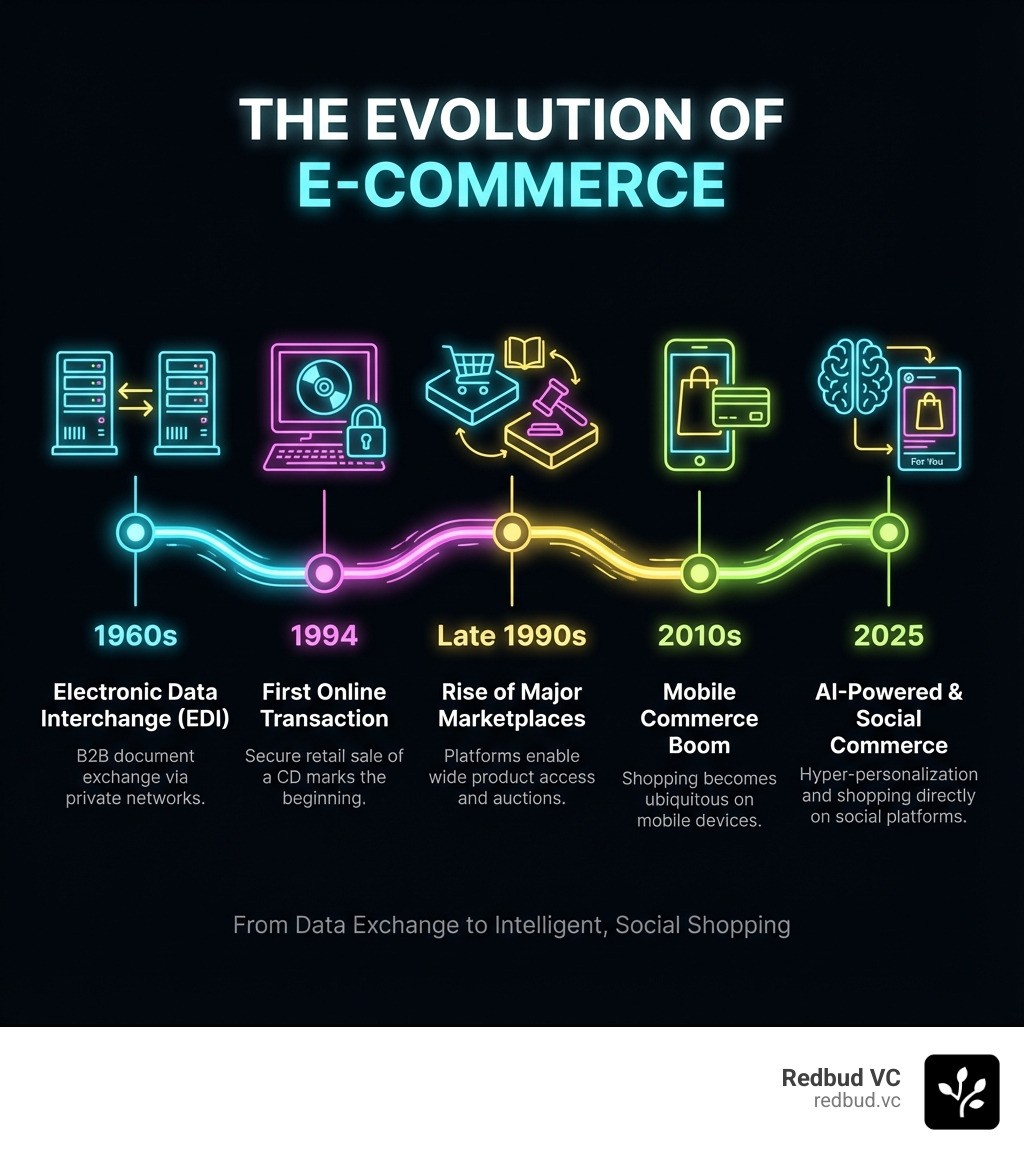
To truly launch a successful e commerce venture, we first need to understand its foundations. The history of e-commerce isn't just about the internet; it dates back to the 1960s with the advent of Electronic Data Interchange (EDI), which allowed businesses to exchange documents electronically. Fast forward to 1994, and the first online transaction—the sale of a CD—marked the beginning of what we recognize today. Since then, it's evolved from simple online storefronts to complex digital ecosystems, embracing everything from mobile shopping to AI-powered personalization.
The landscape is vast and varied, defined by different business models and revenue strategies. Understanding these distinctions is crucial for positioning your e commerce venture for success.
E-commerce Business Models
The way an e commerce venture interacts with its customers and partners defines its business model. While often simplified, there are several key types:
Business-to-Consumer (B2C): This is perhaps the most familiar model, where businesses sell directly to individual end-users. Think of your favorite online clothing store or electronics retailer. Amazon, for example, operates extensively in the B2C space.
Business-to-Business (B2B): Here, businesses sell products or services to other businesses. This often involves larger volumes, specialized products, and recurring purchases. Amazon Business, which offers solutions for reaching business customers, is a prime example.
Consumer-to-Consumer (C2C): These platforms facilitate transactions between individual consumers. Marketplaces like eBay and Etsy allow users to buy and sell directly to each other.
Consumer-to-Business (C2B): In this model, individuals offer their goods or services to businesses. Freelance platforms like Upwork or Fiverr, where individuals provide services to companies, fall into this category.
Business-to-Government (B2G) / Consumer-to-Government (C2G): These less common models involve businesses or individuals selling to government entities. This could range from office supplies to specialized consulting services.
E-commerce Business Model | Description | Examples | Key Characteristics |
|---|---|---|---|
B2C | Businesses sell directly to individual consumers. | Online clothing stores, electronics retailers, Amazon | Focus on consumer satisfaction, emotional purchasing, brand loyalty, often smaller transaction values, large customer base. |
B2B | Businesses sell products/services to other businesses. | Office supply wholesalers, software providers, industrial equipment sales | Longer sales cycles, rational purchasing decisions, higher transaction values, recurring purchases, focus on efficiency and cost savings for the buying business. |
C2C | Consumers sell goods/services to other consumers. | eBay, Etsy, Craigslist | Platform acts as intermediary, varied product quality, peer-to-peer trust, often second-hand or unique items. |
C2B | Consumers sell products/services to businesses. | Freelance platforms (Upwork, Fiverr), stock photo sites | Individuals offer specialized skills or content, project-based work, businesses seeking cost-effective solutions or unique talent. |
B2G / C2G | Businesses or consumers sell products/services to government organizations. | Government contractors, consultants | Complex procurement processes, strict regulations, long bidding periods, focus on compliance and security. |
Common Revenue Models
Beyond the general business model, an e commerce venture needs a strategy for generating revenue. Here are some of the most prevalent:
Dropshipping: This model allows you to sell products without holding any inventory. When a customer places an order, you purchase the item from a third-party supplier, who then ships it directly to the customer. It's a low-risk, low-startup-cost option, making it popular for new ventures. The US dropshipping market is projected to grow to $476.1 billion by 2026.
White Labeling: You sell a generic product manufactured by a third party, but brand it with your own company's name and logo. This offers a quicker path to market than developing a product from scratch.
Private Labeling: Similar to white labeling, but you have more control over the product's specifications, design, and quality. A manufacturer creates a product exclusively for your brand.
Wholesaling: You buy products in bulk at a discounted rate and then sell them individually to customers at a higher price. This requires inventory management but offers better profit margins than dropshipping.
Subscription Model: Customers pay a recurring fee for a product or service delivered regularly. This model thrives on predictable revenue streams and customer loyalty. Most subscription boxes experience a 40-60% profit margin, varying by industry. Dollar Shave Club is a classic example of this model for grooming products.
Print-on-Demand (POD): A variant of dropshipping, where you sell custom-designed products (like t-shirts, mugs, or posters) that are only printed and shipped after a customer places an order. The US print-on-demand market is expected to reach $57.49 billion by 2033. This reduces inventory risk significantly.
Blueprint for Success: How to Start Your E-commerce Venture
Starting your own e commerce venture is an exciting journey, but it requires more than just a great idea. It's a pragmatic process that demands careful planning, strategic execution, and a good dose of resilience. It's like driving a sports car on a curvy road—you're constantly adjusting, accelerating, and braking, often doing many things at once.

Step 1: Find Your Niche and Validate Your Idea
The first step in any successful e commerce venture is finding your unique corner of the market. We encourage our founders to "sell what you know" or to dive into passions and creativity. The more specific you get, the better—at least initially. Don't worry about being too niche; depth often trumps width. As Harvard Business Review suggests, niche markets can evolve into large ones.
Niche Selection: What products do you love? What unique talent or interest do you possess? Is there something missing from the current e-commerce landscape that you can fill? Many profitable ventures began with someone solving a single problem exceptionally well.
Market Demand: Once you have an idea, validate it. Use tools like Google Trends to see what customers are searching for. Look at customer reviews of competitors to identify common complaints or unmet needs. Consider running a simple landing page with targeted ads or offering pre-orders to gauge interest before committing significant resources.
Competitor Analysis: Research similar companies. What platforms do they use? What are their marketing tactics? What makes them successful, and where do they fall short? This helps you understand the market and identify opportunities for differentiation.
Here are some profitable e commerce venture ideas we've observed for 2025, demonstrating the diverse opportunities available:
Niche Apparel: The global apparel market is projected to reach roughly $1.84 trillion by 2025. Whether it's designing t-shirt graphics, catering to a specific subculture, or curating unique styles, focus on a distinct audience.
Print-on-Demand (POD): This low-risk model allows you to sell custom designs on various products without inventory. The US print-on-demand market is expected to reach $57.49 billion by 2033.
Recommerce / Second-hand Fashion: The recommerce global market for apparel is expected to hit $367 billion by 2029, up from $68 billion in 2024. Focus on vintage, upcycled, or luxury consignment.
Beauty Subscription Boxes: These thrive on recurring revenue and expert curation, with most subscription boxes experiencing a 40-60% profit margin.
CBD Products: The global CBD industry will reach between $22 billion and $25 billion in market value by 2025. Find a niche (e.g., CBD-infused food, pet products) and be prepared to educate consumers on regional regulations.
Health and Fitness Products/Services: The US Health & Fitness Club market size is expected to reach $6.96 billion by 2033. Sell courses, e-books, workout routines, or meal plans.
Curated Quality Products: Differentiate by offering a highly personalized, curated selection of niche products.
AR/VR Equipment and Experiences: The global AR/VR market will reach $89.82 billion in 2025. Consider renting equipment for events or creating immersive experiences.
Toys: The global toys market will reach $230.64 billion by 2028. Focus on parents with detailed product info and safety.
Eco-friendly Products: 89% of global consumers have become "greener" in their purchase behavior.
Smart Home Products: Sixty-three percent of US households had at least one smart home device in 2025.
Home Security Products: The global home security system market is estimated to reach $109.4 billion by 2030.
Pet Products and Food: Pet foods and treats in the US alone will reach $157 billion annually by 2025.
Wedding Goods and Services: The global wedding goods and services market will reach $1.84 trillion by 2030.
Online Courses (eLearning): The eLearning market will climb to $325 billion by 2025.
Handicrafts: The global handicrafts market will reach $1.94 trillion by 2033.
Grocery E-commerce: Grocery e-commerce sales are expected to surpass 20% of the total US grocery market by 2026.
Affiliate Marketing: Affiliate marketing will grow to $71.74 billion by 2034.
Step 2: Create a Solid Business Plan and Secure Your Brand
Once your idea is validated, it's time to lay down the groundwork. A robust business plan is your roadmap, documenting your intentions, goals, and deadlines. Studies suggest that business planners are 2.5 times more likely to launch a company.
Business Plan Components: Your plan should outline your company description, market analysis, target customers, financial projections, chosen business model, sales channels, and marketing strategy. This isn't just for investors; it's for you to clarify your vision and track progress.
Choosing a Business Name & Brand Identity: Your name is your first impression. We recommend coming up with a list of names, asking for feedback, and searching online to ensure availability. Your brand identity extends to your logo, fonts, colors, and overall aesthetic. A strong brand helps you stand out in a crowded market.
Securing Your Brand: Consult your local secretary of state's website and the US Patent and Trademark Office to ensure your chosen business name and any potential trademarks are available. You'll also need to choose your legal structure (e.g., LLC) and obtain an Employer Identification Number (EIN) to separate business finances from personal ones.
Step 3: Build Your Online Store and Source Products
With a plan in hand, it's time to build your digital storefront and figure out how to get products into your customers' hands.
E-commerce Platforms: Selecting the right e-commerce platform is critical. Options range from all-in-one solutions like Shopify to open-source platforms like WooCommerce. Consider ease of use, scalability, features, and pricing. A basic Shopify plan, for instance, might cost $29 a month. Some platforms include domain names and hosting, while others require separate providers.
Website Design & User Experience (UX): Your website is your virtual storefront. It needs to be visually appealing, easy to steer, and provide a seamless shopping experience. High-quality product images, clear descriptions, and a smooth checkout process are non-negotiable.
Product Sourcing: How will you acquire your products?
Manufacturing your own: Ideal for unique, handcrafted items.
Buying from wholesalers/distributors: Requires purchasing in bulk, which can offer better margins but necessitates inventory management.
Dropshipping/Print-on-Demand: Low upfront cost, no inventory to manage, but can have lower margins and less control over quality.
Reselling: Sourcing products (new or used) and selling them at a markup. We advise having more than one source for products to mitigate supply chain risks.
Inventory Management: If you're holding inventory, you'll need a system to track stock levels, manage orders, and handle fulfillment. This can be done in-house or by partnering with a third-party logistics (3PL) provider.
Fueling Growth: Investment, Technology, and Scaling
Launching your e commerce venture is just the beginning. Sustained growth in this dynamic market demands continuous adaptation, strategic investment, and leveraging the latest technological advancements.

The Current E-commerce Investment Climate
We've seen venture capital funding in e-commerce rebound in 2024 and gain momentum in 2025. This isn't just a return to business as usual; it's a strategic shift. Investor interest has moved from traditional direct-to-consumer (DTC) brands towards scalable platforms that blend automation, data intelligence, and engagement-first retail.
Evolving Business Models: Investors are looking for companies with SaaS-like revenue models, lower customer acquisition costs (CAC), and sticky user behavior. The focus is on infrastructure that can scale with AI and creator-led sales models.
Investor Priorities: We're seeing increased average check sizes, particularly for companies focused on logistics optimization, customer retention, and creator commerce. VCs are keen on businesses that can operate internationally from day one and diversify beyond single platform dependencies.
Leveraging Technology for a Competitive Edge
Technology isn't just an enabler in e-commerce; it's a differentiator. Incorporating cutting-edge tools can significantly boost your e commerce venture's efficiency and customer appeal.
Artificial Intelligence (AI): AI is revolutionizing operations, from inventory forecasting and supply chain management to personalized product recommendations. Imagine an AI that predicts what your customers want before they even know it!
Automation: Intelligent automation streamlines repetitive tasks, freeing up your team to focus on strategic growth. Shopify's 'Magic' launch in 2024, leveraging AI, is a testament to this trend.
Social Commerce: The lines between social media and shopping are blurring. Platforms like TikTok Shop, Instagram Shopping, and YouTube's integrated checkout are reshaping consumer behavior. Your e commerce venture can thrive by merging content, community, and commerce, creating engaging live shopping experiences and influencer-powered marketplaces.
Verticalized Commerce Platforms: These platforms cater to specific niches (e.g., fashion, gaming, wellness), offering custom experiences and fostering strong community ties.
Scaling Your E-commerce Venture
Scaling involves more than just increasing sales; it means building robust systems that can handle growth without breaking.
Logistics and Supply Chain: Efficient logistics are the backbone of any successful e commerce venture. This includes rethinking global supply chains, exploring micro-warehousing, and regional fulfillment to reduce lead times and improve customer experience.
Fulfillment Solutions: Whether you handle fulfillment in-house, use dropshipping, or partner with a Third-Party Logistics (3PL) provider, your strategy needs to be efficient and reliable. For instance, Amazon's Fulfillment by Amazon (FBA) can save time and reduce operational costs.
Marketing and Advertising: Even the best products won't sell themselves. Invest in digital marketing, social media campaigns, and targeted advertising. When you're starting out, you may want to invest more in marketing and advertising. Deloitte's 2022 CMO Survey reports an average of 13.8 percent of overall budgets going toward marketing activities. Some new e-commerce businesses spend up to 30 percent on customer acquisition.
Customer Retention: Acquiring new customers is expensive—20-40% more for online retailers than traditional ones. Focusing on retaining existing customers is far more profitable. Repeat customers spend more than twice as much after 24 months. Provide excellent customer service, proactively engage, and educate your customers.
Key Performance Indicators (KPIs): Regularly monitor KPIs like conversion rates, average order value, customer lifetime value, and customer acquisition cost. This data-driven approach allows you to optimize strategies and make informed decisions for sustained growth.
Frequently Asked Questions about E-commerce Ventures
How profitable is an e-commerce venture?
The profitability of an e commerce venture can vary wildly, but the potential is significant. For those who find success, the answer is a resounding yes. In the first half of 2021 alone, e-commerce businesses generated a whopping $408.51 billion.
Average Sales Data: More than 60% of sales in the Amazon store are from independent sellers, most of which are small and midsize businesses. Independent sellers in the US averaged more than $290,000 in annual sales in the Amazon store in 2024, and over 55,000 generated over $1 million in sales that same year.
Profit Margins: As mentioned, subscription boxes often see 40-60% profit margins. Dropshipping typically has lower margins but also lower overhead. Your niche, product pricing, and operational efficiency will heavily influence your ultimate profitability.
Independent Seller Success: The sheer volume of independent sellers achieving substantial annual sales demonstrates the viability of online businesses.
How much does it cost to launch an e-commerce business?
One of the most attractive aspects of an e commerce venture is the relatively lower barrier to entry compared to brick-and-mortar stores. However, "low cost" doesn't mean "no cost."
Startup Costs Breakdown:
Platform Fees: Software like Shopify can cost $29-$79 a month. Open-source platforms are free to download but require hosting and potentially developer fees.
Domain Name & Hosting: A domain name can be as little as $1 a year, while hosting can range from a few dollars to hundreds per month.
Product Inventory: This is often the largest variable cost. Dropshipping and print-on-demand models virtually eliminate this upfront cost. Wholesaling or manufacturing your own products will require significant initial investment.
Marketing Budgets: Especially when starting out, a significant portion of your budget might go towards marketing and advertising (up to 30% for customer acquisition).
Licenses and Permits: These costs vary by location and industry, but are essential for legal operation.
Potential for Low-Cost Models: If capital is a constraint, options like dropshipping or affiliate marketing allow you to start with minimal upfront investment, focusing primarily on marketing and customer service.
What are the biggest challenges for new e-commerce businesses?
While the opportunities are vast, we'd be remiss not to address the problems. Starting an e commerce venture is not without its challenges.
Competition: The low barrier to entry means intense competition. You're not just competing with local businesses but global players. Standing out requires strong branding, unique value propositions, and excellent customer experience.
Supply Chain Disruptions: Global events can significantly impact supply chains, leading to delays, increased costs, and inventory shortages. Building resilient supply chain relationships is crucial.
Customer Acquisition Costs (CAC): As mentioned, acquiring customers online can be expensive. Effectively managing your marketing spend and finding cost-effective channels is vital.
Technology Dependence: An e-commerce business relies heavily on technology. Website crashes, payment gateway issues, or platform downtimes can directly impact sales and customer trust.
Marketing Effectiveness: The digital marketing landscape is constantly evolving. What worked last year might not work today. Continuous learning and adaptation are necessary to reach your target audience effectively.
Adapting to Market Shifts: Consumer preferences, technological advancements, and regulatory changes can happen quickly. Businesses must be agile and ready to pivot to stay relevant.
Conclusion
The world of e commerce venture is a vibrant, changing landscape ripe with opportunity for those with vision, drive, and a strategic approach. We've seen how much the market has grown, with global e-commerce sales projected to reach an astounding $8.09 trillion in 2028, and the US market alone projected to hit $1.7 trillion by 2028, making up nearly 20% of all retail transactions.
From understanding the diverse business and revenue models to carefully planning your launch and leveraging cutting-edge technology, every step is a building block toward success. While challenges like fierce competition and supply chain complexities exist, the digital tools and investment opportunities available today make it an incredibly exciting time to start on an e commerce venture.
At Redbud VC, we believe in the power of discerning resilience—the ability to not only envision a groundbreaking future but to adapt and thrive through the inevitable challenges. If you're building an early-stage tech company with a compelling vision for the future of e-commerce, we're always looking for founders who embody this spirit.
