There are two ways to build a company:
Stay at home and build under constraints.
Move to the place where you believe you have the best chance of success, aka where the best resources are (talent, capital, etc.).
Most cases follow the second path. But when 1 aligns with the right mindset + skillset, it’s special. And often taken for granted.
The conventional wisdom, reinforced by decades of capital flow and carried interest, is that great tech companies come from two places: SF and NY. The data looks convincing on the surface — until you look at where some of the biggest names in tech actually came from.
Marc Andreessen was born in Cedar Falls, Iowa. He was raised in New Lisbon, Wisconsin, a place he described as "the sticks," the son of a Lands' End customer service operator and a seed company sales manager. He taught himself basic programming at age nine, and while studying at the University of Illinois, he and a colleague built Mosaic, the first user-friendly web browser with graphics — an invention that changed how every human on earth accesses information.
Sam Altman was born in Chicago, and his family moved to Clayton, Missouri when he was four. He grew up in the suburbs of St. Louis. He eventually dropped out of Stanford and built OpenAI in California.
At 18, Shegun Otulana moved to Birmingham, Alabama from Lagos, Nigeria to attend the University of Alabama at Birmingham. Two decades later, he sold Therapy Brands for $1.25 billion — one of the largest software exits in Alabama history. He didn't leave when he had the money. He announced plans to build 40 new startups in Birmingham over the next ten years, with aggregate valuations in the billions. His thesis: constraints aren't a reason to leave. They're a reason to stay. When he could only raise $250,000 in ten months for his healthcare SaaS company, he turned that into motivation — without the luxury of burning cash, he had to build profitably from day one.
And then there's Willy and Jabbok Schlacks. The Schlacks grew up in a rural Missouri community with no formal education, taught themselves to code, and built EquipmentShare from scratch — a construction tech company that reached $4 billion in revenue and went public on the Nasdaq earlier this year. They built it in Columbia, Missouri. Population 130,000.
The misconception is that you have to build by water to be successful. As a VC, we want to fund a basket of opportunities. That includes the ambitious person uprooting their life to go to San Francisco to build, because they believe this is their best chance of success, and the person passionate about building at home who operates under different constraints. One founder is in the comfort of their home and may be closer to customers, but is underrated, while the other is building in a new place with unlimited access, but life is taking a back seat to the business.
Now and then, Venture Capital still shows its cottage industry roots. It’s a small industry with ~6,000 investors across 3,500 firms in the US. At that scale, a few loud investors and deals can shape the industry's voice. On the surface, it is an echo chamber, and from a talent perspective, it is, with 60% of investors coming from Harvard and Stanford. On top of that, although there are talented people, under pressure, our psychology defaults to biased investment decisions. This is reflected in the stat that 30% of VC deals are tied to an investor's alma mater; therefore, you can assume 18% of deals are Stanford and Harvard alums.
Investors pitch LPs on differentiation and access, but those are tried-and-true sales tactics. The industry is full of tourists and masked privilege. Everyone has an angle with networks, so being kind, honest, and assiduous is a differentiator for winning allocations with founders, but that doesn’t hold up in the LP court when it comes to securing a multi-fund commitment. We’ve even been told, “You’re not posted up at coffee shops in SF every day, so you can’t win deals there.”
There is certainly an argument to be made that if we see an SF deal, it’s probably already been picked over, so why is this Missouri fund getting a look? This has surely happened, and maybe someone’s pass is someone else’s treasure. No one knows what will truly happen with a company at the Pre-Seed stage, but having the versatility to remove any bias and strip an opportunity down to what matters is a skill in itself. Backing people who don’t give up is what truly matters, not where they are based. Someone’s roots are part of the story and a data point to support conviction.
More than ever, talent is moving to San Francisco to chase ambitious dreams, which is why we invested in the residency, which has a global network of hackerhouses that feed into the San Francisco house. This gives us a first look at people who are self-selecting for the kind of mentality we seek. Many of these entrepreneurs are immigrants and/or have Midwest roots.
Some of the most durable companies in history were built by people who had no choice but to be resourceful. Columbia, Missouri, punches above its weight — with companies like Zapier, EquipmentShare, StorageMart, Veterans United, and Carfax, it has an outsized concentration of billion-dollar companies for a city its size. That's not a coincidence. When you build without a safety net, you build things that work.
The research on this is consistent. Capital-constrained founders tend to reach profitability faster. They make fewer vanity hires. They stay closer to the customer because they have to. They don't have the luxury of the "figure it out later" mentality that abundant Series A capital can afford. Struggle, as it turns out, is a feature — not a bug. That’s just another reason why: the greatest driver of venture returns is resilience.
The irony is that the investors best positioned to identify this advantage are the ones closest to it. The Midwest isn't a consolation prize for founders who couldn't make it to the coasts. It's a filter — one that tends to produce founders with unusually high pain tolerance, unusually tight unit economics, and unusually strong reasons to prove something.
Andreessen built the browser that played a major role in opening the internet to the world. Altman is building the technology that may reshape it again. Otulana built a billion-dollar company in a city most VCs can't find on a map. Schlacks built a $7 billion equipment company in a college town in Missouri. Don’t sleep on the midwest.
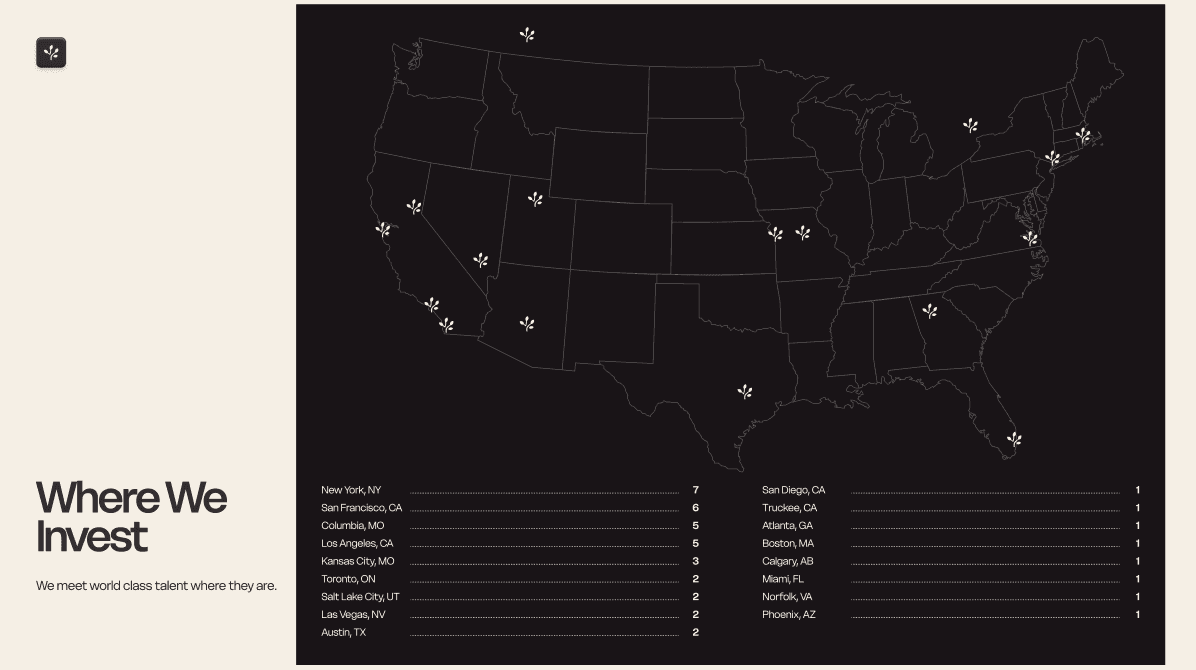
At Redbud VC, we aren’t regionally focused. We invest in world-class talent wherever they are. Help us fill out this map, and pitch us today.