
Over the last five years, I've met with more than 5,000 entrepreneurs while building Redbud VC from mid-Missouri into a nationally known fund. One conclusion: talent is everywhere. Network connectivity is not.
Great entrepreneurs find a way, whether that means moving to San Francisco or staying home.
S-tier builders operate from first principles: time with customers first, capital second, and hire A-players when it hurts. Growth attracts capital, and network effects with customers and talent are what accelerate growth, no matter where the company is built.
The largest companies in the world were built by people from under-the-radar places. Some moved to connectivity. Some stayed. Where you start doesn't cap what you build.
But those roots and affinities are the guiding point to deepening connections and a sense of community.
We saw it firsthand. I posted an Outsider Roots NYC event on X and got over 100 DMs, each a paragraph on why someone was an outsider. In San Francisco, we packed a room with top AI talent with Midwest roots.
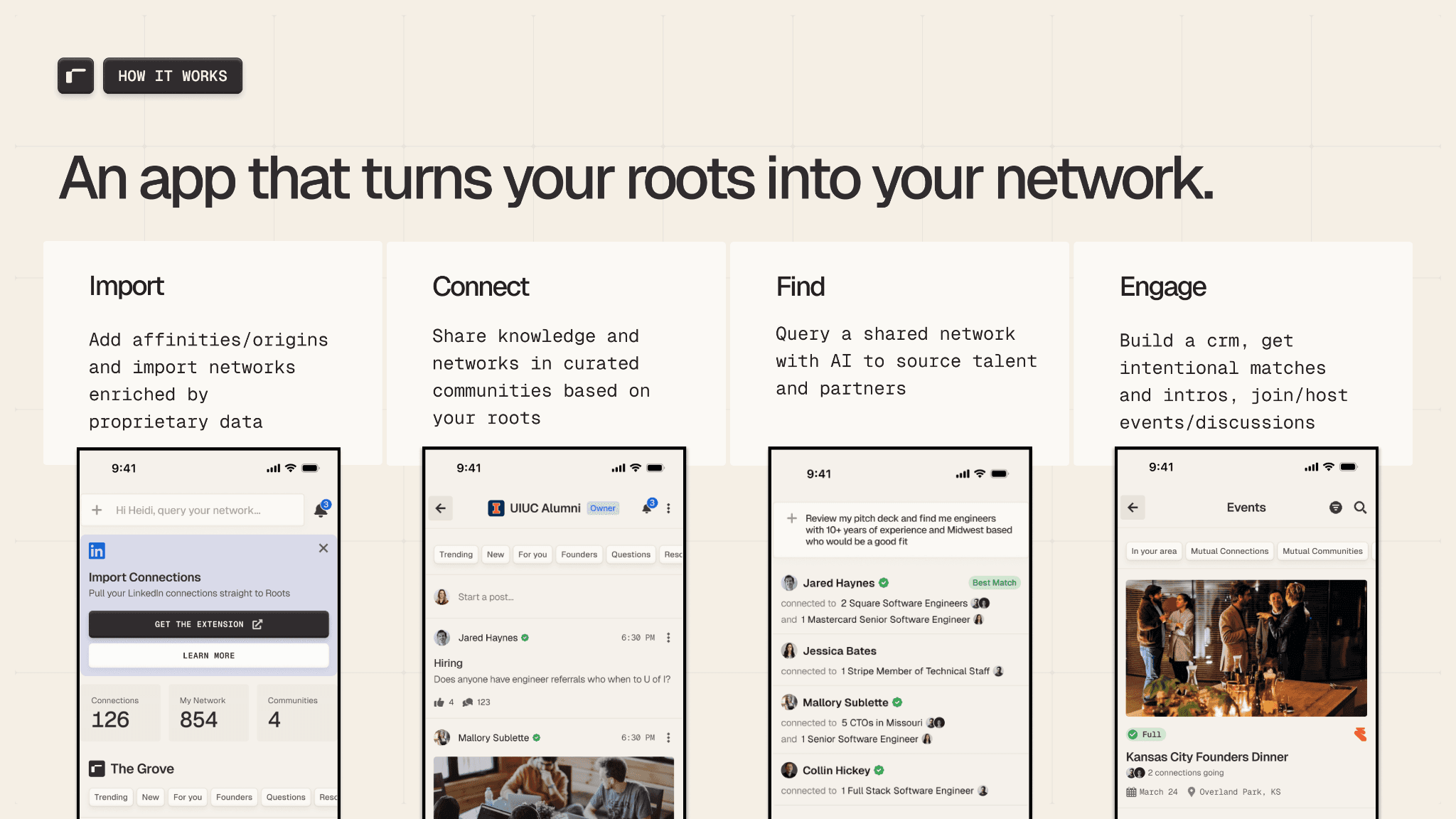
That's why we built Roots: a social platform connecting founders, talent, investors, and enterprises through shared roots. Import your network and Roots enriches it with AI. As you connect with members and join communities, their networks layer into yours. Roots is a shared graph you can query in plain English to find the right co-founder, customer, hire, or investor through the warmest path that already connects you, online and in real life.
Network graph: See your connections and shared context visualized, and find the warmest path to anyone in the network.
AI search: Query your extended network in plain language to find the right customer, hire, or co-founder through someone who already knows you both.
Communities: Join groups organized around industry verticals, geographic roots, and shared backgrounds where the people you meet already have a reason to trust you.
Enterprise partners: We’re starting with Missouri and the Midwest, where talent and company density is high but startup connectivity is not. Curated companies that joined specifically to work with startups before the rest of the market does.
Host: Create and manage events directly on Roots, with built-in matchmaking that surfaces the top three people you should meet at the event.
Events: Roots runs curated dinners and happy hours in New York, San Francisco, Chicago, Atlanta, Miami, and across the Missouri Roadshow through St. Louis, Kansas City, Columbia, and Springfield. No panels or pitches. This year, we're launching the Roots Startup Summit, fka Missouri Startup Weekend, bringing together founders from across the country, enterprise partners, and investors who back people from places nobody was watching.
THE PROBLEM ISN'T TALENT
Paul Graham wrote in 2008 that "great cities attract ambitious people. You can sense it when you walk around one. In a hundred subtle ways, the city sends you a message: you could do more; you should try harder."
He's right. The problem is that most of the world's most ambitious people aren't in those cities.
After 5,000 conversations, I'm confident the biggest problem for most founders isn't capital. It's network connectivity.
And it runs deeper than getting someone to take a meeting. The founders who succeed need a critical mass of early believers, people who give honest feedback during discovery, sit through a rough MVP, and stay patient long enough to become actual pilot customers. Early customers and talent exist everywhere. In dense startup ecosystems, founders find them quickly through overlapping networks. Everywhere else, it takes longer, not because the people aren't there, but because the infrastructure to surface them hasn't existed.
If you grew up in San Francisco or went to Stanford, some of this gets solved before you ever start. A professor makes an intro. Your college roommate's dad is at the firm you're pitching. Your network is already compounding on day one.
In Columbia, Missouri, or Wichita or Pittsburgh, that kind of ambient deal flow and warm intro density has to be manufactured from scratch.
The science on this has been settled for sixty years. Stanley Milgram's small-world experiments in the 1960s, which started with packets mailed from Wichita and Omaha, found that any two Americans were connected by five or six intermediaries. Facebook measured its own graph in 2016 and got 3.5. And when researchers replicated the experiment globally in 2003, they found something else: the people who successfully navigated those chains did it through geography and occupation, through where someone was from and what they did. The paths were always there. People find them through roots. What never existed was the instrument that shows you the warmest one.
The misconception is that places like the Midwest simply don't have enough people. The data doesn't support that. The talent is there. The operators are there. The domain knowledge runs deep across industries that have defined these regions for generations. What's missing isn't people. It's connection density, the rate at which the right people find each other and participate in building something together. The networks are fragmented across geography, and the culture in many of these communities has historically leaned toward trade and industry knowledge rather than the startup ecosystem that could form around it. The raw material for exceptional company building exists everywhere. The infrastructure to activate it is what's been missing. Until now.
From those 5,000 conversations, I can tell you this isn't a Missouri problem. Founders from rural markets, secondary cities, and under-the-radar places all over the country carry the same affinities and the same frustration. They didn't grow up without ambition. They grew up without access. What they lacked in access, they made up for in ambition. Can you imagine what they'd accomplish with the same network access as those on the coasts? The Midwest resonates so deeply with founders everywhere who came from a place like it because it stands for something specific: most of the world's best builders never got the infrastructure their talent deserved.
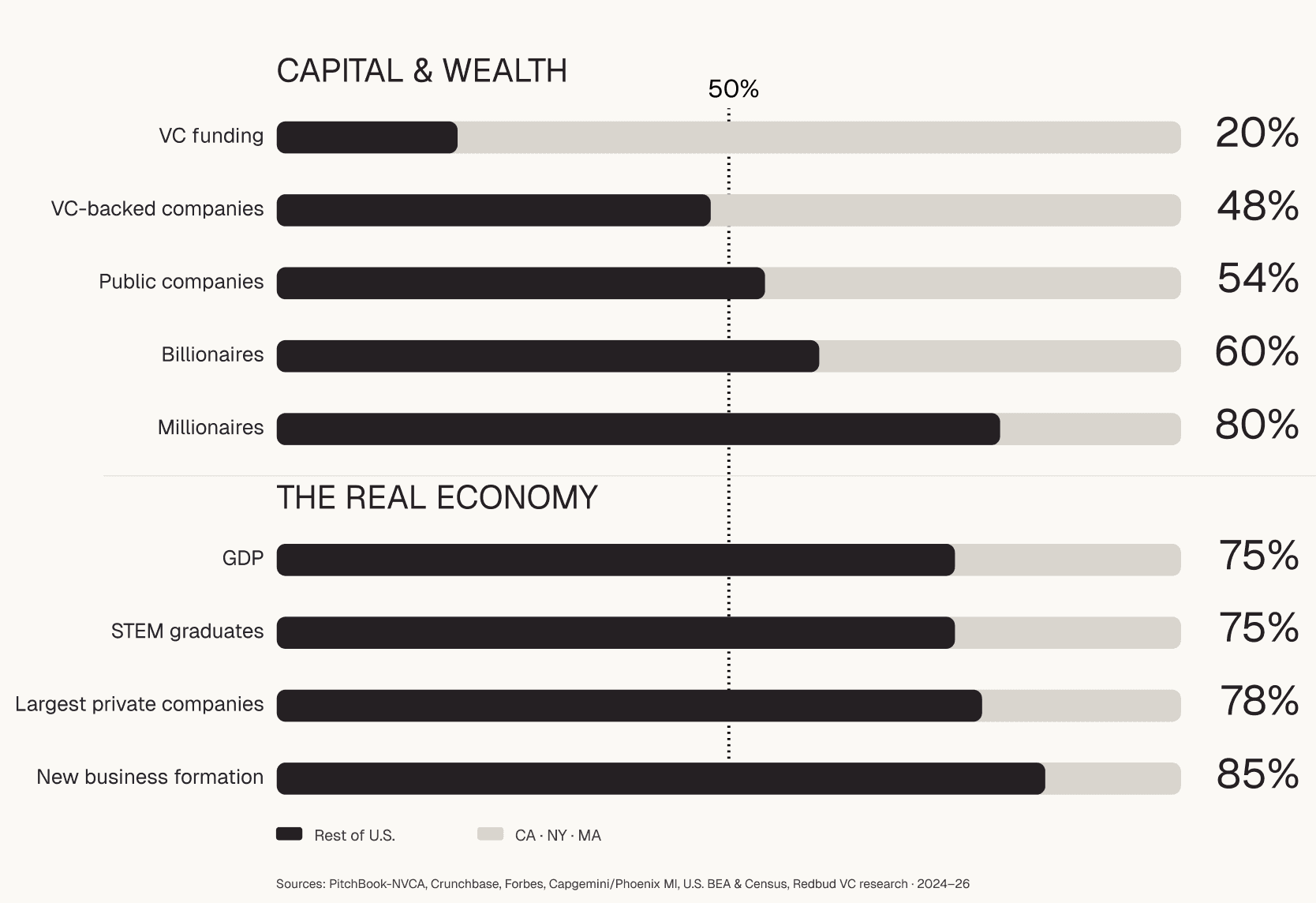
75% of the US GDP comes from outside California, New York, and Massachusetts. 85% of new businesses start outside those three states. 77% of the largest private companies in the country are headquartered outside them. Venture capital and the network infrastructure that helps early-stage companies survive still concentrate there anyway.
THE PROOF OF CONCEPT IS ALREADY HERE
Columbia, Missouri, has a population of 126,000.
When a tier-one VC invested in EquipmentShare, they told the founders they couldn't be successful if they weren't by water. The Schlacks brothers stayed in Columbia. EquipmentShare is now one of the largest YC-backed companies in history.
That story is our whole thesis.
Columbia is also home to Zapier, bootstrapped to close to $140 million in ARR and still run from the same city where it started. Carfax. StorageMart is the largest privately-owned self-storage company in the world. Veterans United is the largest VA home lender in the United States. Columbia has one of the highest concentrations of billion-dollar companies per capita of any city in the world.
That's before you count what Mizzou has produced. Sam Walton went to school here and built the world's largest company by revenue. Richard Kinder got his law degree here and built Kinder Morgan into one of the largest energy infrastructure companies in North America. Stan Kroenke got his MBA here and built a sports and real estate empire spanning the NFL, NBA, NHL, and Premier League. Hayes Barnard graduated here and built GoodLeap into a fintech unicorn. Dmitriy Karpman earned his undergraduate degree here before co-founding Hive, now one of the world's leading enterprise AI companies.
One university in one mid-sized Missouri city. That's the network density nobody talks about. Well, except me.
Willy and Jabbok Schlacks didn't build EquipmentShare because they had the right connections. They had deep domain knowledge of their customer. The type of knowledge that only comes from someone who grew up around that industry. The network would have compressed its timeline. The roots made it defensible.
They did it without the network. The next generation does it with both.
OUTSIDERS BUILD UNICORNS
Stanford professor Ilya Strebulaev published the Unicorn Report in April 2025. It's the most rigorous look at who actually builds billion-dollar companies I've come across.
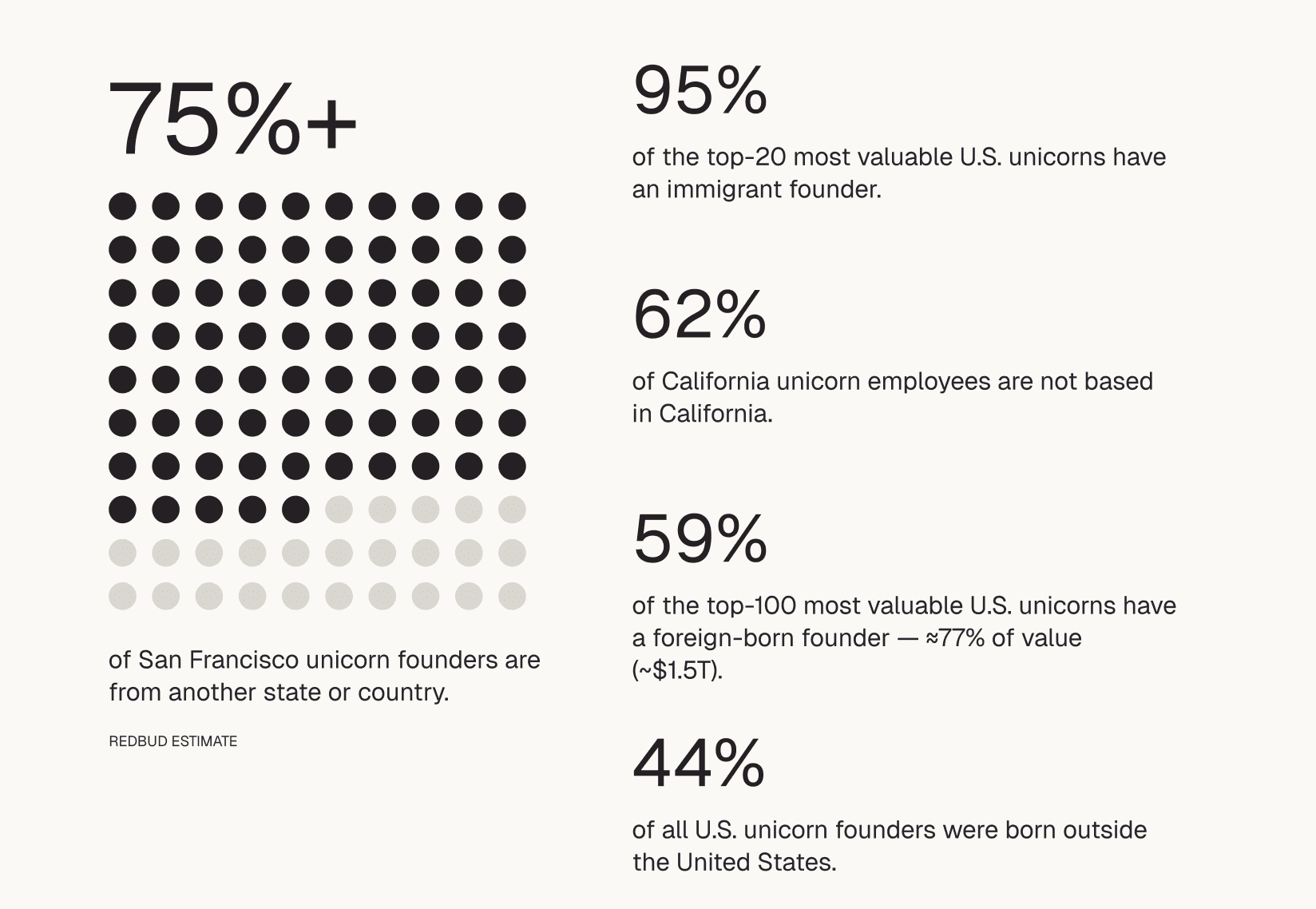
44% of US unicorn founders were born outside the United States. 60% built their billion-dollar company on their first attempt. 78% had never been a CEO before. The dropout rate among unicorn founders is 250% higher than the general population.
None of that fits the pattern-matching most VCs rely on when evaluating deals.
Here's the part that gets missed in the conversation about Silicon Valley. The ecosystem doesn't produce these founders. According to Silicon Valley Bank's State of the Markets data, 59 of the top 100 US unicorns have at least one foreign-born founder, representing roughly $1.5 trillion in combined valuation. 19 of the top 20. And only 38% of employees at California-based unicorns are actually in California. The people building the most valuable companies in America came from somewhere else, carried something with them, and the place they landed got the credit.
At Redbud, 65% of our portfolio is immigrants or founders with Midwest roots. That’s not because we set out to build a geographically-themed fund, but because when we stopped filtering for the familiar credentials and started underwriting the intangibles, resilience, resourcefulness, and customer insight built from proximity to the problem, that's who remained.
What the Stanford data doesn't fix is the structural disadvantage those founders operate under. A warm intro that takes one text in San Francisco takes six months of cold outreach in Kansas City, if it happens at all. A founder building exactly what a company needs never surfaces in their deal flow because there's no graph connecting them. The investor who would have led their round went to the same state school but never knew it.
THE MINDSET PROBLEM NOBODY TALKS ABOUT
Parts of the Midwest carry a cultural default toward stability that directly conflicts with what venture-scale company building actually requires.
Bootstrapping a profitable company and living well are legitimate outcomes. But the same environment that celebrates them can quietly convince founders capable of something much bigger that the ceiling is lower than it is. That raising capital is reckless. That thinking beyond a certain size is arrogance. The American version of relentless work and outsized ambition doesn't always have a home in the communities where the most interesting founders are hiding.
Then there's the advice problem. Outside the main hubs, the stage fills with people who want to help, most of whom haven't raised institutional capital, scaled a company, or sat across from a Series B investor. The founders who break through figure out early whose input actually counts and ruthlessly build their networks around the people who have played the specific game they're trying to play.
Roots fixes exactly that. Not to make company building easier, because constraints drive outlier returns, and that shouldn't change. The point is to make sure the right founders are in the right rooms, getting counsel from people who have actually done it, and finding early customers and partners through warm rather than cold paths. It all starts with your curated network on Roots.
WE SAW IT IN PERSON
We hosted a Midwest Roots event in San Francisco.
The room was packed, and the energy was unlike anything I'd seen at a professional event in a long time. Founders and investors who had spent years building careers in the most connected city in the world and had never once had a room where being from somewhere else was the whole point.
There’s one conversation that I still think about to this day. Someone who'd been in the Bay Area for over a decade said the closest thing they'd had to this feeling was discovering that a founder they admired had gone to the same small school back home. That one thing changed the entire relationship. Two years of professional acquaintance turned into a real friendship in the span of one dinner.
It happens constantly, whenever people find out they share something real. It's almost always accidental. Roots makes it intentional.
THE PEOPLE WHO PROVED IT
Marc Andreessen grew up in New Lisbon, Wisconsin, with a population of 2,500. He built the first commercial web browser in a computer lab at the University of Illinois. Sam Walton grew up in Columbia, Missouri, went to Mizzou, and built the world's largest company by revenue from rural Arkansas. Jack Dorsey grew up in St. Louis writing dispatch software as a teenager. Sam Altman grew up in St. Louis. Warren Buffett has run Berkshire from Omaha his entire career. MrBeast grew the largest YouTube channel in his hometown. By choice.
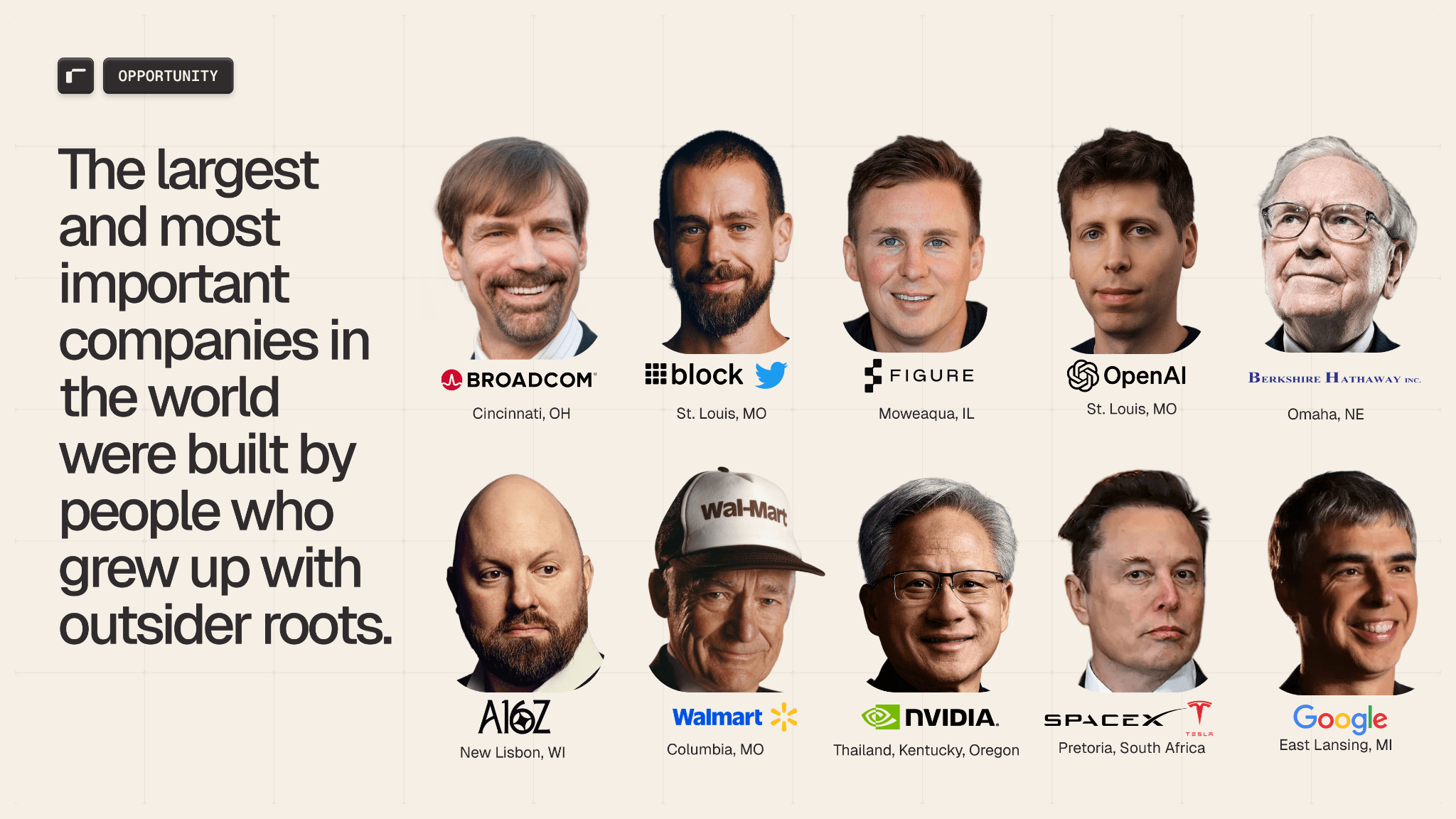
Eric Yuan was denied a US visa eight times. He moved on the ninth attempt and built Zoom into the communications infrastructure the world ran on during a pandemic. Jensen Huang was born in Taiwan, raised in Thailand, moved to the US at nine, and built NVIDIA into the compute layer powering the AI era. Patrick and John Collison came from a town in rural Ireland with maybe a hundred people and rebuilt the internet's payment infrastructure. Max Levchin came from Ukraine at sixteen with almost nothing and co-founded PayPal.
Brett Adcock grew up in Moweaqua, Illinois. Population 1,800. He's building Figure AI, one of the most closely watched humanoid robotics companies in the world.
There's now infrastructure being built to connect people like this to each other before they have to figure it all out alone. That's what Roots is.
THE PLACES NOBODY IS WATCHING
Lebanon, Missouri, has a population of 15,000. The world's largest barrel manufacturer is headquartered there. Independent Stave Company has been family-owned since 1912, operates on six continents, and employs over 2,600 people. Every bottle of bourbon aged in American oak has probably touched one of its barrels. Most people have never heard of the company or the city.
Wichita is the Air Capital of the World. More aircraft are built there than anywhere else on earth. White Castle started there in 1921. Pizza Hut in 1958. Koch Industries, the second-largest private company in America, runs from there.
Bentonville, Arkansas. 54,000 people. The highest-revenue company in the world.
These aren't exceptions. Just because Tech Twitter doesn't talk about it, doesn't mean it's not reality. They're what happens when people build where they're from, with close customer proximity and domain depth, without performing for an audience that wasn't paying attention anyway.
ACCESS SHOULDN'T BE A BIRTHRIGHT
You have to earn the right to win in the market. But network access is a different thing entirely.
Finding the right early customer, co-founder, or investor through someone who already knows you both is the most impactful lever in any founder's early trajectory. It's the infrastructure of opportunity. And right now, it gets allocated by zip code and alma mater far more than by the quality of what someone is building. That’s backward.
Entrepreneurship shouldn't be pay-to-play. Constraints drive outlier returns, and that won't change. But the founder in Nebraska or Tennessee or rural Illinois with a unique idea and the drive to build it deserves the same shot at finding the right people as someone who grew up with a network.
Roots is leveling that playing field. Where you started should be an asset. We built it so it is.
The waitlist is open today.
roots.build
Tell us your roots. That's where it starts.
Brett Calhoun
GP, Redbud VC
Founder, Roots
Sources: Ilya Strebulaev et al., Unicorn Report, Stanford Venture Capital Initiative, April 2025. Silicon Valley Bank, State of the Markets: H2 2025. Paul Graham, Cities and Ambition, paulgraham.com, May 2008.Travers and Milgram, An Experimental Study of the Small World Problem, Sociometry, 1969. Dodds, Muhamad, and Watts, An Experimental Study of Search in Global Social Networks, Science, 2003. Facebook Research, Three and a Half Degrees of Separation, 2016.
Originally posted at: https://roots.build/blog/why-i-built-roots/